
The Slowness of Film Photography
Notes on time, imperfection and the art of observing slowly.
Film photography teaches patience before it teaches technique.
Nothing appears immediately.
There is no instant confirmation, no endless correction, no continuous acceleration of images.
Only the quiet uncertainty of waiting.
A frame is exposed and disappears into darkness for days, sometimes months, before returning as memory made visible.
Perhaps this is why analog photography changes the relationship between attention and time so deeply.

In a world dominated by speed, film photography feels almost resistant.
It asks for slowness.
For hesitation.
For presence.
Every frame carries weight because it cannot be repeated infinitely.
And gradually the act of photographing becomes more intentional, more silent.
You begin to observe longer before pressing the shutter.
Light becomes something to study rather than consume.

What always fascinated me about film was not nostalgia.
It was imperfection.
Dust on negatives.
Soft focus.
Unexpected light leaks.
Colors altered by time and temperature.
The image no longer feels entirely controlled.
And perhaps this loss of control allows photographs to feel closer to memory itself:
fragile,
incomplete,
emotionally unstable.


Traveling with analog cameras also changes movement.
The process becomes slower and more attentive.
You stop photographing constantly.
You wait longer.
You observe more carefully.
A road in morning fog.
A reflection crossing a train window.
A distant figure disappearing into dust.
Small moments begin to matter again.
Not because they are spectacular,
but because they carry atmosphere.
Perhaps this is what film photography preserves better than anything else:
the emotional texture of time.
Not perfect reality.
Not visual precision.
But the sensation of having inhabited a moment fully enough for it to leave a trace.
And in an age of infinite digital images, this slowness begins to feel increasingly precious.
Almost human.
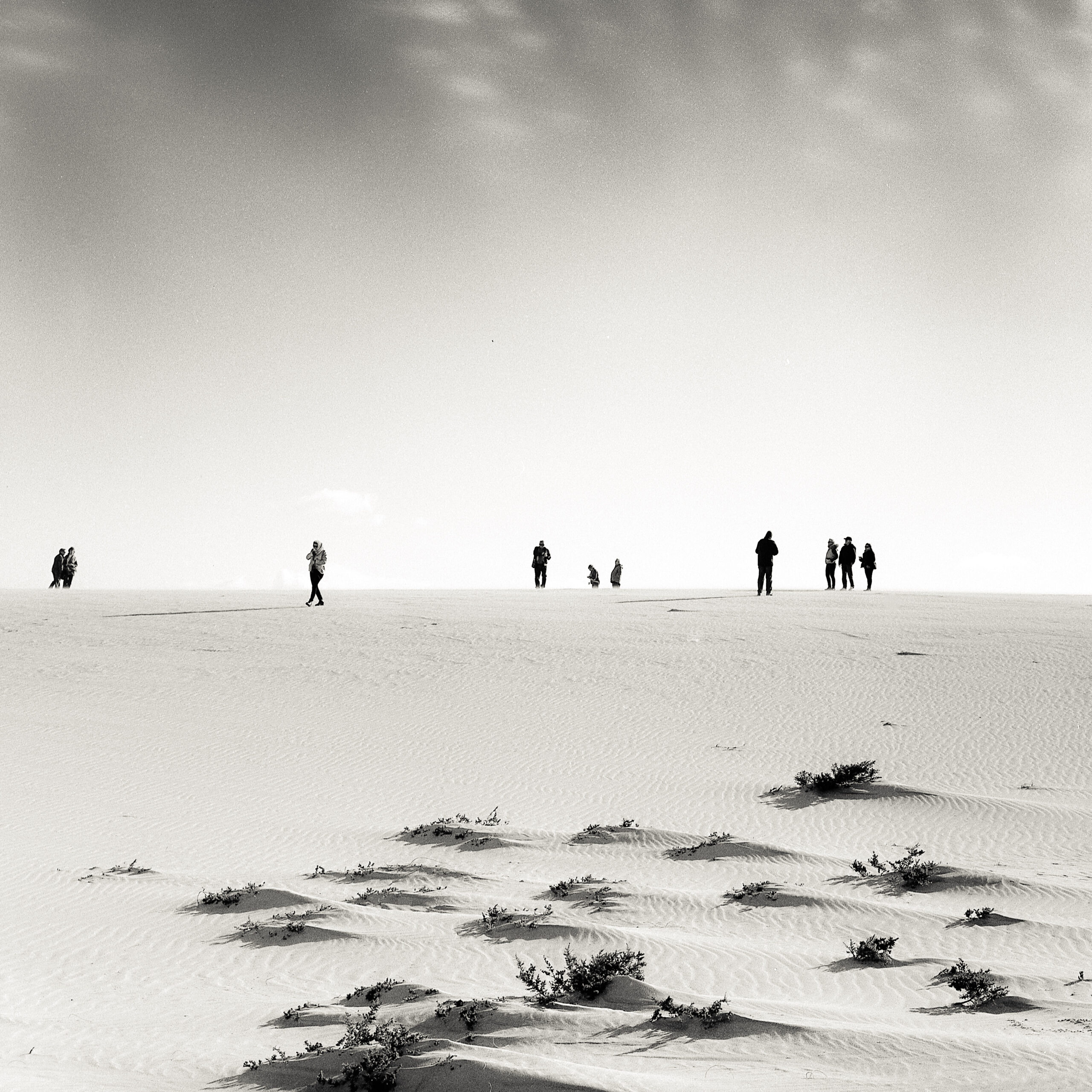
Some photographs survive not because they are technically flawless,
but because they contain the fragile imperfection of lived experience.
A softness.
A silence.
A memory slowly dissolving into grain.