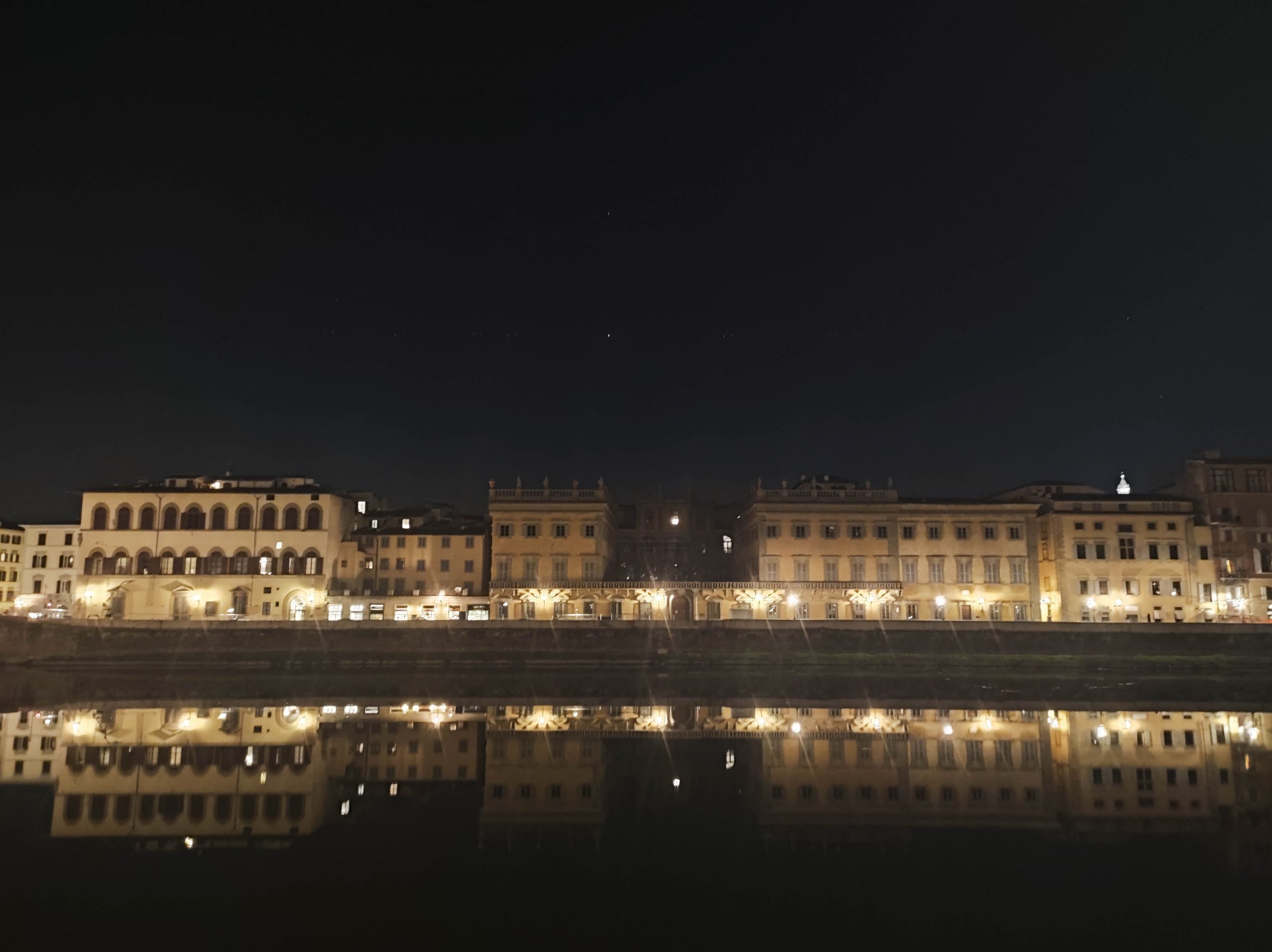
Nights Along The Arno
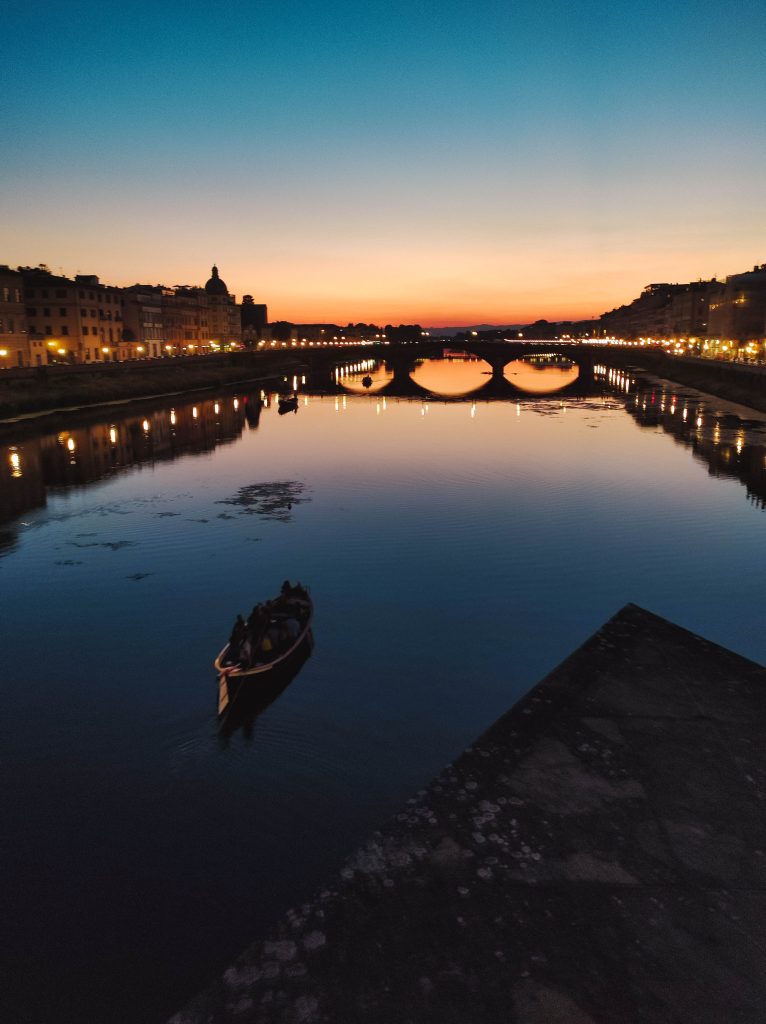
Night Photography in Florence:
Lights Along the Arno
Florence changes completely after sunset. As the crowds slowly disappear, the city begins to reveal another rhythm — shaped by reflections, silence and warm light dissolving across the Arno River. The version of Florence that most photographers document is the daytime version: the Duomo, the Uffizi, Piazzale Michelangelo at golden hour. The night version is quieter, less photographed and, in many ways, more interesting.
The River Arno is not merely a natural element flowing through the city. It is the constant baseline — much like the basso continuo in Baroque music — that binds together the diverse architectural backdrops of the palaces. Without the open and fluid spatiality of the Lungarni, Florentine architecture would lose its visual rhythm.
Why Night Photography in Florence Works Differently
Night photography in Florence requires a different relationship with the camera than daylight work. The exposure times extend — five seconds, ten seconds, sometimes a full minute on the Lungarno — and within that duration, the city moves in ways that daylight cannot produce. A cyclist crosses the Ponte Vecchio and becomes a streak of light. The water below, which in daylight shows every ripple, flattens into a surface of dark silk broken only by the reflections of the lanterns above.
Photography here becomes less immediate. The strongest images rarely come from monuments alone, but from atmosphere: dimly lit streets with rain reflecting across stone pavements, solitary figures crossing bridges at the hour when the restaurants have just closed, empty cafés before shuttering, shadows dissolving slowly along the riverbanks. These are not planned photographs. They are found ones — by someone willing to be present in the city at the hour when most visitors have returned to their hotels.
The Arno transforms the city after dark. Light stretches across the water while the Renaissance architecture loses its monumental presence and becomes softer, more intimate and almost cinematic. The palazzi along the Lungarno Corsini and the Lungarno degli Acciaiuoli, which in daylight are imposing blocks of stone, become warm rectangles of amber light repeated and distorted in the moving water below them.
The city before it performs for tourists. The Tuscany photography workshop includes Florence at pre-dawn and evening. Individual mentoring. Maximum 4 photographers. From €1,000. Discover the Tuscany Workshop →
The Best Positions for Night Photography Along the Arno
The Ponte Santa Trinita is the most underrated viewpoint for night photography in Florence. Less crowded than the Ponte Vecchio and perfectly positioned to frame it — the medieval bridge in the middle distance, the Lungarno receding to the left, the reflections stretching toward the camera in the still water after midnight. A tripod is essential here, and the best conditions are on evenings after light rain, when the pavement of the bridge itself becomes a second mirror and the lanterns multiply.
The Ponte Vecchio itself is best photographed from the Oltrarno side — specifically from the Lungarno Torrigiani, looking north toward the bridge and the Uffizi above it. The orange-lit windows of the goldsmith shops on the bridge create a warm horizontal band across the middle of the frame that the Arno reflects below. This composition is most effective between ten and eleven at night, when the shop lights are still on and the foot traffic on the bridge has diminished enough to allow clean long exposures.
The Ponte alle Grazie, further east, offers a less familiar version of the Florentine waterfront — the Arno wider here, the buildings less famous, the atmosphere correspondingly more intimate. From this position, looking west toward the city, the domes of Santa Croce and the distant silhouette of the Duomo are visible above the roofline, and the light-to-shadow ratio changes completely from the central Lungarno positions.
 Florence at night · The Lungarno · © Raffaele Ferrari
Equipment and Approach for Night Photography in Florence
For night photography along the Arno, a tripod is not optional — it is the essential piece of equipment. The exposure times required to render the water as a smooth reflective surface and the lanterns as continuous points of warm light range from four seconds to two minutes depending on the available light level and the desired effect. A remote shutter release eliminates camera shake at the moment of exposure. Mirror lockup, on cameras that offer it, removes the vibration of the mirror movement from long exposures.
A wide angle lens — 24mm or 28mm equivalent — works best for the panoramic Lungarno compositions. A 50mm prime is more useful for tighter frames on the bridges themselves, isolating the architectural detail and the reflection without the converging verticals that wider focal lengths introduce in the narrow spaces between buildings.
White balance is the most important creative decision in night photography in Florence. Auto white balance will attempt to neutralise the warm amber of the city’s lanterns — which is precisely the quality that makes the night city beautiful. Setting the white balance to daylight or slightly cool (5000-5500K) preserves the warmth of the artificial light and produces images that feel like the city actually looks after dark.
Perhaps this is the Florence that remains most deeply in memory. Not the city of museums and crowded viewpoints, but the quieter moments unfolding slowly between reflection, movement and silence.When to Photograph Florence at Night
The blue hour — the twenty minutes immediately after sunset when the sky retains a deep blue that balances the warm artificial light of the city — is the most productive window for night photography along the Arno. During this brief period, the tonal range between the brightest and darkest parts of the scene is narrow enough for a single exposure to contain both. Before the blue hour, the sky is still too bright. After it, the sky goes completely black and the lanterns become isolated points of orange in an otherwise dark frame.
The blue hour in Florence shifts with the season — arriving at 5pm in December and pushing past 9pm in June. The longer blue hours of summer are paradoxically more difficult than the short winter ones, because the tourist activity in the city at 9pm in July is still considerable. For this reason, the most productive months for night photography in Florence are October through February, when the blue hour arrives early, the pedestrian traffic on the bridges is minimal, and the mist that sometimes settles over the Arno in November and December adds a diffused quality to the lantern light that summer cannot produce.
At night, Florence becomes less about history and more about atmosphere. A place where photography begins to follow emotion rather than destination. The city that remains after the museums close and the tour groups return to their coaches — this is the Florence that a long exposure and a still tripod can finally make.
The city before it wakes and after it sleeps. The Tuscany photography workshop includes evening sessions in Florence — long exposure, the Arno, the bridges after dark. Maximum 4 photographers. Individual mentoring. From €1,000. Discover the Tuscany Workshop →
Photograph Florence — Essential Guide · Best Sunrise Photography Spots in Florence · Photograph the Hills of Florence · Photography Workshop in Tuscany · How to Photograph Val d’Orcia · All Photography Workshops




One Comment