How Photograph Val D’Orcia
How to Photograph Val d’Orcia: Geometry, Silence and the Architecture of Mist
Val d’Orcia has been framed millions of times. The cypresses, the winding roads, the isolated farmhouses — every postcard image already exists.
Yet for a visual artist, the challenge is not to document what the valley looks like. The challenge is to capture what it feels like when you are the only presence under a blank sky at five in the morning, watching the mist move.
I was born and raised in Tuscany and have been photographing this landscape for fifteen years. This is not a guide about GPS coordinates. It is a visual essay about patience, perception, and the architecture of empty space.
The Geometry of the Rural Landscape: Stripping Away the Postcard
When you look at the hills of Val d’Orcia through a telephoto lens — typically a 70–200mm to compress the fields — you are not simply looking at nature. You are looking at a landscape shaped by centuries of sharecropping history and human design.
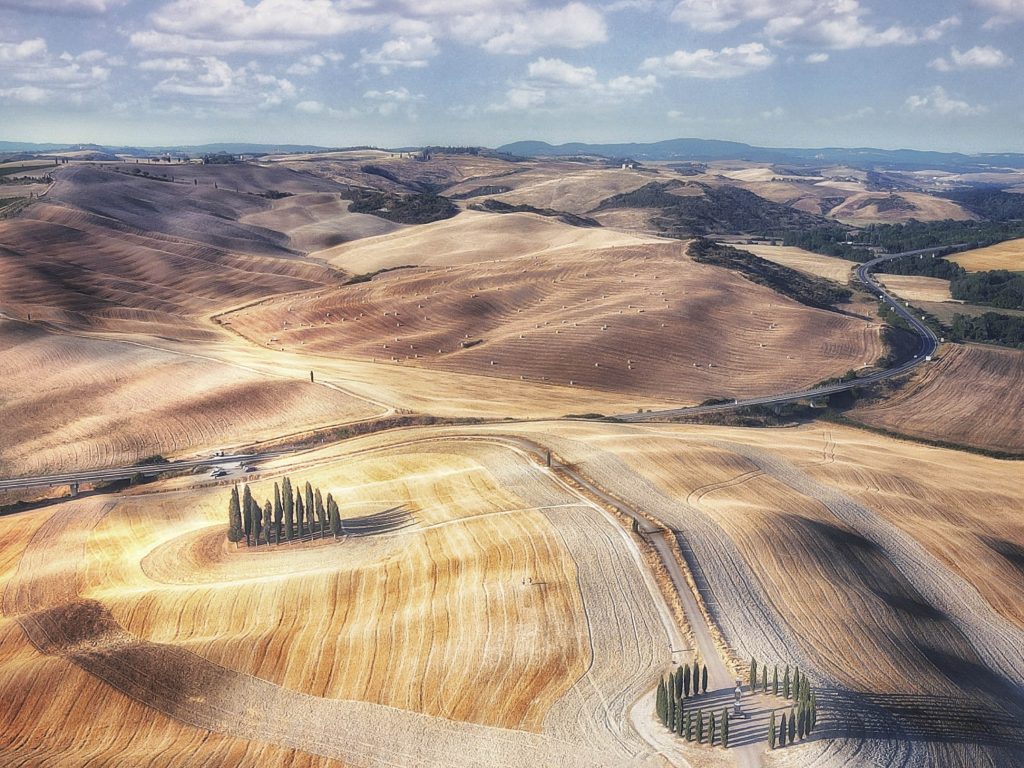
It is an exercise in pure geometry. The crests of the clay hills form minimalist, overlapping waves. A solitary cypress cuts through the horizontal rhythm like a vertical counterpoint. The strade bianche — white gravel roads — act as leading lines drawing the eye toward an isolated farmhouse, a symbol of solitude made visible.
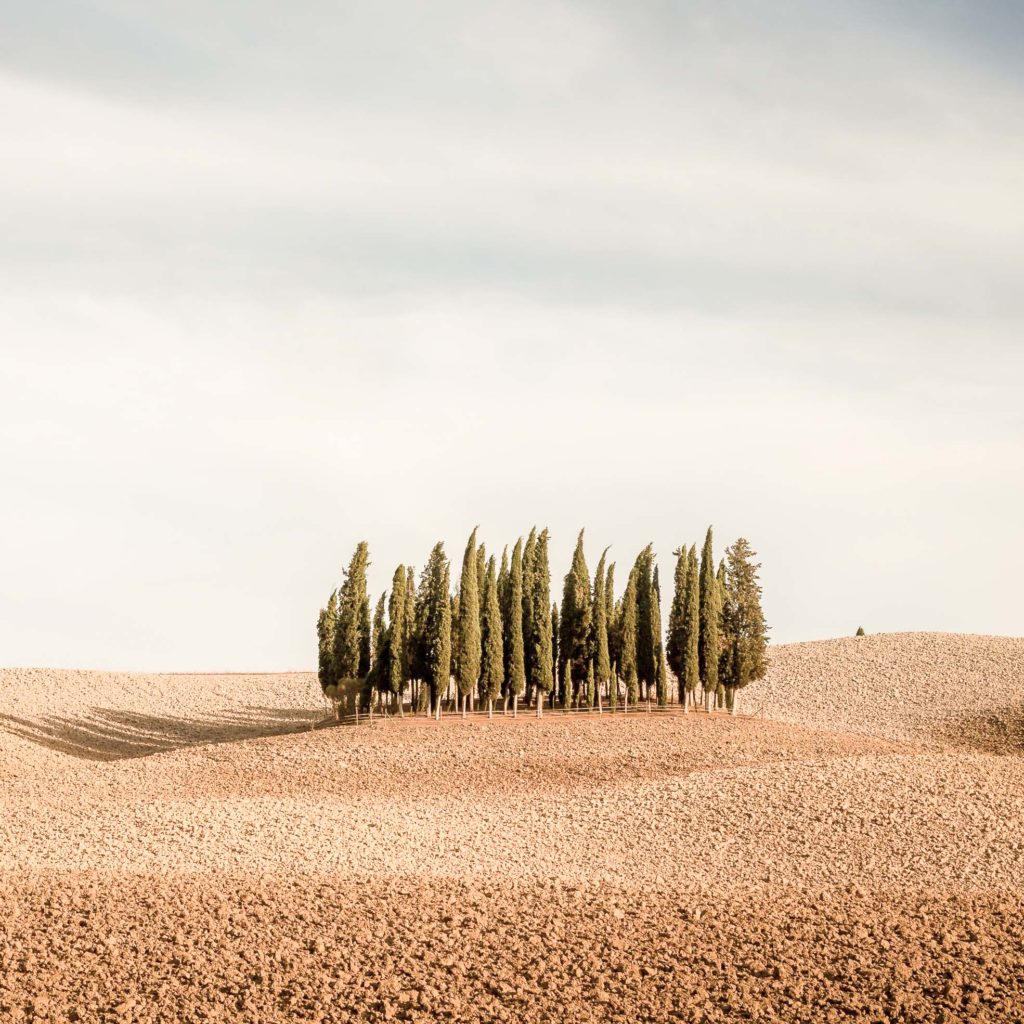
To avoid the cliché, look for abstract compositions. Strip the image of geographical context. Seek the interaction of textures in ploughed soil and the way a single shadow can alter the entire weight of a hillside.
The Psychology of Waiting: How to Photograph Val d’Orcia at Dawn
My background in psychology informs how I perceive a landscape before raising the viewfinder. In Val d’Orcia, photography is deeply tied to the concepts of transition and anticipation.
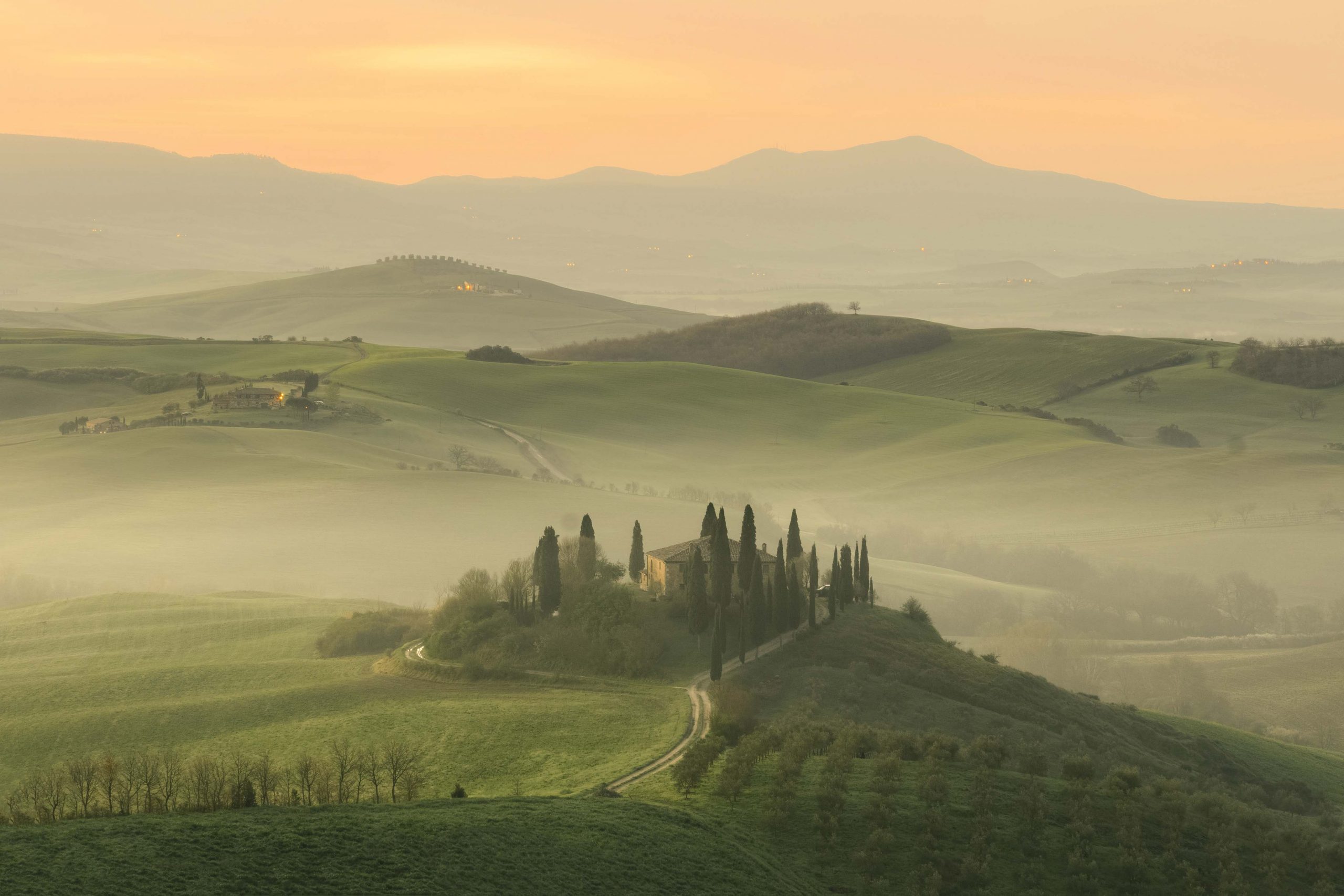
The valley reveals its deepest soul at 5:00 AM, long before the tourist buses arrive. This is when thermal mist rises from the ground and settles into the dips of the hills. The mist acts as a natural minimalist filter — it simplifies the world, hides the roads, isolates the farmhouses on their ridges and turns the landscape into a sequence of fading tonal layers.
Photographing this phenomenon is a psychological meditation. You stand in the cold, watching the white canvas shift slowly under the first rays of low, golden light. You are not merely waiting for the sun. You are waiting for the exact second where the tension between visibility and disappearance is perfectly balanced.
The single most reliable month: October. Cold nights create morning fog. The autumn light is warm and low. The roads are empty before 7 AM. If you can visit only once, go in October.
Best Season to Photograph Val d’Orcia: Light, Fog and Atmosphere by Month
Every season produces completely different images from the same locations. This table is the fastest way to match your travel dates to what you can realistically expect to photograph.
| Season | Conditions | What to Photograph | Best For |
|---|---|---|---|
| Spring Apr – May |
Green hills, wildflowers, morning fog through mid-April. Soft overcast light. | Cypress roads with green fields, wildflower foregrounds, misty valleys at dawn. | Classic Val d’Orcia image. Best for a first visit. |
| Summer Jun – Aug |
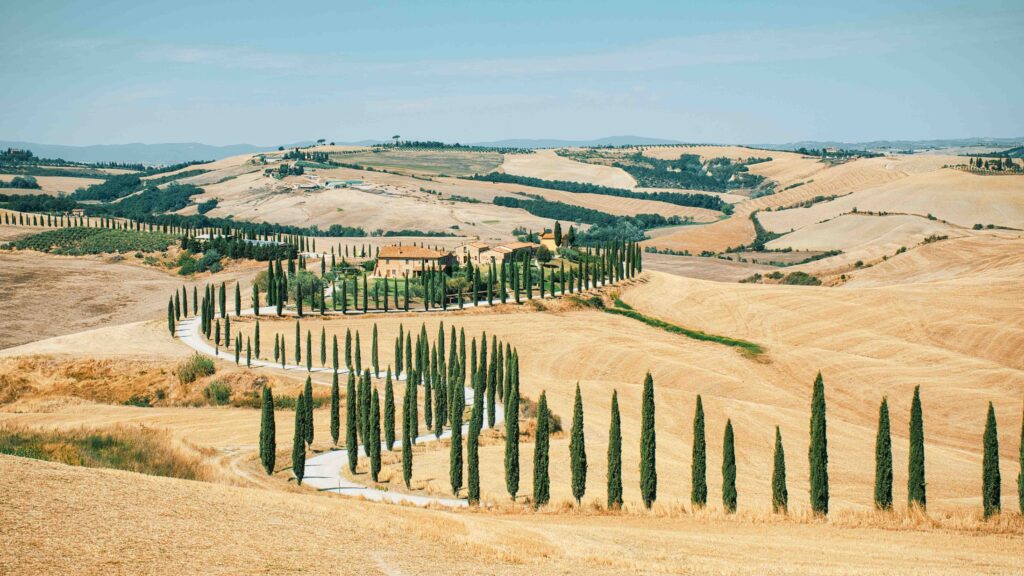
Golden straw fields from July, long golden hours, no fog. Crowds from 9 AM. | Sunrise in solitude before 6 AM. Golden fields with cypress. August storms. | Warm tones. Requires very early starts. |
| Autumn ★ Sep – Nov |
Reliable fog from mid-October. Low angle light. Fewer tourists. Best atmospheric conditions of the year. | Fog layers between hills, Belvedere farmhouse in mist, cypress roads with depth. | Best season overall. October and November are my first recommendation. |
| Winter Dec – Mar |
Bare vines, silver light, occasional snow. Complete solitude. Minimalist landscape. | Abstract compositions, ploughed field geometry, rare snow on cypress roads. | Most private season. Entirely underrated. |
Best Photography Locations in Val d’Orcia: Four Places Worth Returning To
These are not simply viewpoints to visit. They are visual problems to solve — each one changes completely depending on the hour, the season and the density of the morning air.
-
Podere Belvedere
One of Tuscany’s most iconic farmhouses. Best in autumn fog at sunrise, when the building catches directional light against misty hills. The key is patience — fog movement can alter the scene within minutes. Never leave this location too early. -
Cappella della Madonna di Vitaleta
A small chapel surrounded by cypress trees and rolling hills. Best at sunset with soft clouds. Avoid shooting too wide — simplicity works best here. A 200mm lens compresses the chapel against the hills into something almost abstract. -
Poggio Covili — The Gladiator Road
One of the most recognizable roads in Tuscany. Use long focal lengths, work with curves and leading lines. Light direction is essential — the road reads completely differently at sunrise versus sunset. -
Cypress Roads Near San Quirico d’Orcia
Perfect for minimalist landscape photography. Look for symmetry and negative space. Early morning fog often creates the strongest results — and the least competition.
Visual Logic: Composition Principles for the Val d’Orcia Landscape
Most photography guides tell you where to put your tripod. A coordinate cannot give you a personal vision.
Simplify the scene. One of the most common mistakes is trying to include too much. Focus on one subject, remove distractions, use clean lines. Minimal compositions almost always work better in this landscape than comprehensive, busy ones.
Use layers. Val d’Orcia is naturally stratified. Foreground hills, middle-ground fog and background light create depth and spatial presence. Three distinct tonal layers in a frame transform a flat record into something with real atmosphere.
Work with light direction. Side light is almost always more effective than flat front light. Shadows across the hills create texture, form and tonal contrast. Without them you have documentation. With them, you have a photograph.
Stay longer than you think you need to. Some of the strongest images I have made in Val d’Orcia came from staying at a single location two hours past the moment when I thought the light was finished.
Experience Val d’Orcia at Dawn — With Someone Who Has Photographed It for Fifteen Years
Exact timing, fog conditions, positioning. A private cultural experience in small group, not a photography tour. Food and wine encounters included. Val d’Orcia is a core location in every Tuscany experience.
Recommended Gear and the Most Common Mistakes Photographers Make in Val d’Orcia
Gear matters far less than timing and light. A basic setup used at the right moment will always surpass expensive equipment used at the wrong time of day.
What to bring: a wide-angle lens (16–35mm) for expansive compositions, a telephoto (70–200mm) for layers and compression of the hills, a tripod for low light and fog, and a remote shutter release.
The mistakes are almost always the same:
Arriving too late. Most iconic locations work best at or before sunrise. By 9 AM the light is flat and the viewpoints are crowded.
Ignoring weather. Fog and clouds create more powerful images than clear blue skies. The days that feel uncertain are usually the most productive.
Overcomplicating the composition. Val d’Orcia rewards restraint. The less you include, the more you say.
Only photographing the famous spots. Some of the strongest scenes happen between the famous locations, on the secondary clay roads, in the spaces that have no name on any map.
Frequently Asked Questions
What is the best time to photograph Val d’Orcia?
Sunrise is essential. The first hour of light creates fog, depth and clean compositions impossible to achieve later in the day. October and November offer the most reliable fog conditions. Spring (April–May) offers the green hills and wildflowers that define the classic Val d’Orcia image.
What season is best for Val d’Orcia photography?
Autumn (October–November) is the best season overall — reliable fog, warm light, empty roads and extraordinary atmospheric conditions. Spring (April–May) is best for green hills and wildflowers. Winter is underrated — complete solitude and minimalist landscapes. Summer requires arriving before 6 AM.
Where are the best photography locations in Val d’Orcia?
Podere Belvedere, Cappella della Madonna di Vitaleta, Poggio Covili (the Gladiator Road), and the cypress roads near San Quirico d’Orcia are the classic locations. The Crete Senesi nearby is equally rewarding with far fewer photographers.
How do I photograph Val d’Orcia without other tourists in the frame?
Arrive before sunrise. The famous locations are empty before 6:30 AM in summer and 7:00 AM in other seasons. This is the single most effective technique — and it also gives you the best light.
Can I join a photography workshop in Val d’Orcia?
Yes. Val d’Orcia is a core location in every Tuscany experience I lead. The Photography Workshop in Tuscany — available in 3, 7 and 10-day formats — dedicates full sessions in Val d’Orcia at sunrise and sunset, with direct guidance on timing, positioning and fog conditions.



8 Comments