
Photograph Humayun’s Tomb

Photograph Humayun’s Tomb: The Monument That Taught the Taj Mahal How to Be Beautiful
Every photographer who visits Delhi photographs the Red Fort, the Qutb Minar and the Jama Masjid. Far fewer make the journey to Humayun’s Tomb — and those who do are often surprised to find themselves standing in front of a monument that, in many ways, is more photographically interesting than the Taj Mahal that it inspired.
Built in 1570 by the widow of the Mughal Emperor Humayun, this is the first garden-tomb on the Indian subcontinent — the prototype for an architectural tradition that would culminate, eighty years later, in the white marble perfection of Agra. Where the Taj Mahal is famous for its surface, Humayun’s Tomb rewards attention to its structure: the geometry of the char bagh garden, the alternation of red sandstone and white marble in the facade, the sequence of arched corridors that frame the central dome from different distances and angles.
Humayun’s Tomb is a photographer’s monument rather than a tourist’s monument. It requires movement, patience and the willingness to abandon the main axis and find the angles that most visitors never discover.
India photographed with intention. The Rajasthan photography expedition includes Delhi and Humayun’s Tomb as part of a ten-day journey through northern India. Maximum 4 photographers. Heritage accommodation included. Discover the Rajasthan Expedition →
Why Humayun’s Tomb Is the Most Underrated Photography Subject in Delhi
The Taj Mahal is photographically exhausted. Every angle, every hour of light, every atmospheric condition has been documented millions of times. Humayun’s Tomb, which shares the same architectural DNA and in some respects the same visual grandeur, has been photographed a fraction of that number — which means the images available here can still be genuinely yours.
The complex has undergone extensive restoration in recent years, completed by the Aga Khan Trust for Culture. The red sandstone has been cleaned and consolidated, the char bagh garden replanted according to the original Mughal design, and several secondary monuments within the complex — the tomb of Isa Khan, the Nila Gumbad — have been restored to their original condition. The result is a photography environment of extraordinary coherence and visual richness that is, on most mornings, significantly less crowded than any comparable monument in northern India.
The Geometry of the Char Bagh Garden
The char bagh — the four-part garden divided by water channels that is the defining formal element of Mughal tomb architecture — is the most distinctive photography subject at Humayun’s Tomb. From ground level, the water channels create leading lines that direct the eye toward the central plinth of the tomb. From the elevated position of the plinth itself, looking back over the garden toward the main gateway, the geometry of the garden becomes fully readable — the four quadrants, the intersecting paths, the pattern of the replanted garden within the original Mughal layout.
The most productive approach to photographing the char bagh is to work it from multiple positions — from the main gateway looking in, from the central plinth looking out, and from the lateral paths that run along the garden’s perimeter. Each position reveals a different relationship between the garden geometry and the monument above it.
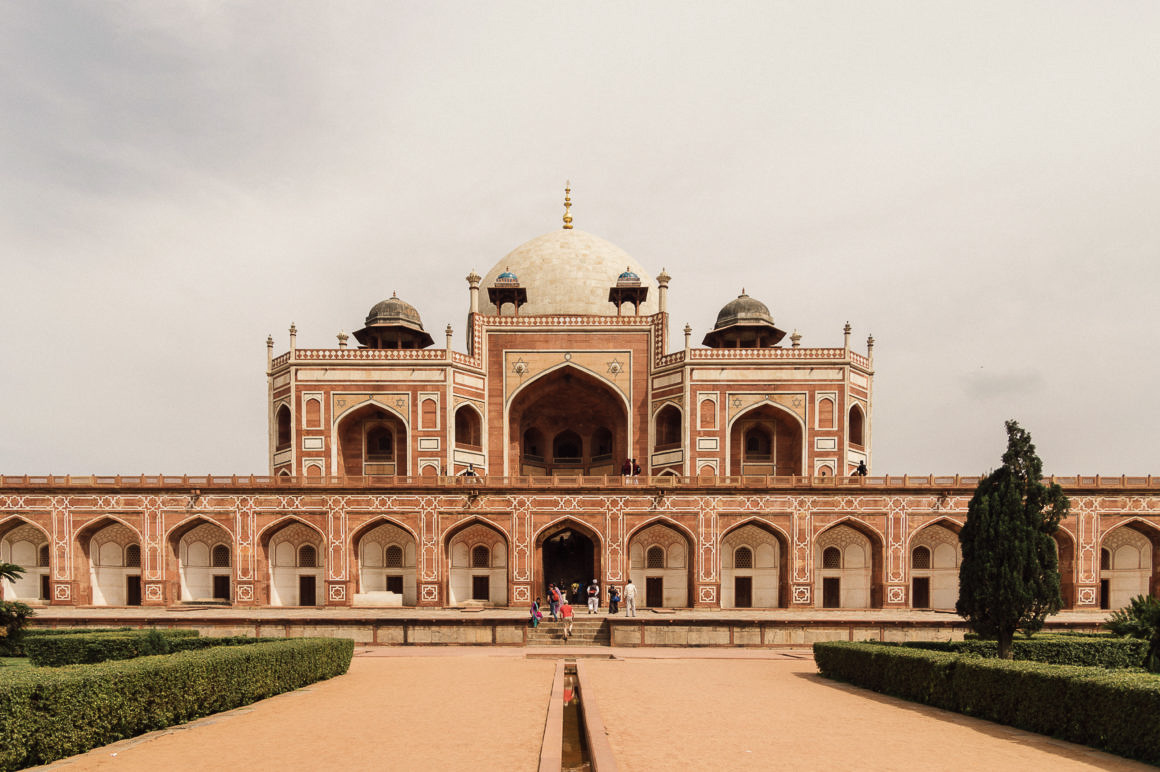 Humayun’s Tomb, Delhi · The char bagh garden — the geometry that taught the Taj Mahal · © Raffaele Ferrari
The Best Light for Photographing Humayun’s Tomb
The orientation of Humayun’s Tomb — the main facade faces west — determines the optimal photography hours completely. The west-facing facade is in shadow for most of the morning and receives the direct light only from the early afternoon onward. The east side of the monument, which receives the first light of the morning, offers a completely different visual register from the famous frontal view.
Morning — The East Side and the Garden
Arrive at opening time — 6am year-round, with slight seasonal variation. In the first hour after sunrise, the light arrives from the east at a low angle and illuminates the side of the monument in a way that reveals the texture and colour of the red sandstone with extraordinary clarity. The char bagh garden, still in partial shadow, produces a tonal contrast between the lit stone of the plinth and the dark green of the replanted garden below.
The morning is also the time to explore the secondary monuments within the complex — the octagonal tomb of Isa Khan, built twenty years before Humayun’s Tomb and photographically extraordinary in its own right, is at its best in the morning light that arrives at a low angle through the gateway openings of its enclosure.
Late Afternoon — The Main Facade at Golden Hour
The west-facing main facade of Humayun’s Tomb receives the best light in the final hour before sunset. The combination of the warm golden light and the deep red of the sandstone, with the white marble inlay illuminated from a low angle, produces the image that defines this monument in photography. Arrive at the main gateway one hour before sunset and work the frontal composition as the light shifts through its final arc.
Delhi’s air quality affects the quality of this light significantly. In winter — November through February — the air is clearest and the late afternoon light has a quality that the summer and monsoon months cannot produce. The pollution that characterises Delhi for much of the year settles after dark and partially clears in the cold nights of winter, producing conditions at the hour before sunset that are exceptional.
Practical Information — Photograph Humayun’s Tomb
- Opening hours: Sunrise to sunset, every day including public holidays
- Best months: October to March — clear air, low light angle, manageable temperatures
- Best hours: First hour after opening (morning side) and last hour before sunset (main facade)
- Tripod: Permitted — no restrictions inside the complex
- Drone: Not permitted inside the ASI protected area
- Getting there: Hazrat Nizamuddin Metro Station (Violet Line) — 15 minutes on foot or 5 minutes by auto-rickshaw
- Combined visit: Safdarjung’s Tomb — 10 minutes by auto-rickshaw — is worth photographing in the same morning session
Where to Stand — The Angles Most Photographers Miss
The canonical photograph of Humayun’s Tomb is made from the main western gateway, looking east along the central axis of the char bagh garden toward the monument. It is a genuinely beautiful composition — the symmetry of the garden, the framing of the gateway arch, the monument centred at the end of the axis. It is also the photograph that every visitor makes.
The Lateral Gateway Approach
The complex has two lateral gateways — one to the north, one to the south — that offer oblique views of the monument across the garden. These angles reveal the three-dimensionality of the building in a way that the frontal axis cannot: the dome seen from a diagonal position, the corner towers reading against the sky at an angle, the relationship between the main structure and the octagonal corner pavilions visible simultaneously. These are compositions that require moving away from the central axis and accepting a less symmetrical but more spatially rich view of the monument.
Inside the Corridors
 Humayun’s Tomb · Interior corridors — arched openings and the garden below · © Raffaele Ferrari
The interior arcaded corridors of Humayun’s Tomb — accessible from the plinth level — offer one of the most extraordinary interior photography environments in Delhi. The sequence of arched openings, each framing a view of the garden below, the alternation of light and shadow in the corridor itself, the geometric pattern of the sandstone and marble floors — these are subjects that reward the photographer willing to put down the wide angle and work with a 35mm or 50mm prime in confined light. The quality of light inside the corridors changes completely with the position of the sun: in the morning it enters from the east at a low angle and illuminates the floor pattern; in the afternoon it enters from the west and lights the corridor ceiling.
The Isa Khan Enclosure
The tomb of Isa Khan, inside the same complex to the northwest of the main monument, is one of the most overlooked photography subjects in Delhi. The octagonal sandstone mausoleum, built in 1547 — twenty years before Humayun’s Tomb — is surrounded by its own char bagh enclosure with a mosque on the west side. The scale is more intimate than the main monument and the photography is correspondingly less obvious: the carved sandstone screens, the view of the mosque from the tomb platform, the garden within the enclosure in the morning light.
Arrive before the tour groups. Move away from the main axis. Work the light inside the corridors. The images that are yours are almost never made from the obvious position.How to Photograph Humayun’s Tomb — The Approach That Works
The mistake that most photographers make at Humayun’s Tomb is spending the entire visit on the main axis — approaching along the central path, making the frontal composition from the gateway, climbing to the plinth for the elevated view of the garden, and leaving. This takes forty minutes and produces images that could have been made by anyone.
The productive approach requires at least two hours and a different sequence. Begin at the Isa Khan enclosure when it opens — the morning light is best here and the crowds arrive later than at the main monument. Move to the main monument and work the eastern side in the morning light before the frontal facade receives direct sun. Enter the corridors and spend time on the interior photography before the temperature inside rises. Save the main frontal composition for the late afternoon return, when the western light illuminates the facade at the angle that makes it extraordinary.
This is the approach I use when I lead photographers to Delhi as part of the Rajasthan photography expedition. Delhi is the opening chapter of the Rajasthan journey — the city that establishes the visual grammar of Mughal India before the journey moves through Agra, Jaipur, Jodhpur and Pushkar.
Maximum 4 photographers. Heritage accommodation. Ten days through northern India — from the Mughal monuments of Delhi to the extraordinary documentary photography of the Pushkar Camel Fair. Individual mentoring. Heritage accommodation included. Discover the Rajasthan Expedition →
Rajasthan Photography Expedition — Pushkar Camel Fair · How to Photograph Jodhpur — the Blue City · Kerala Photography Workshop · Kerala vs Rajasthan — Which Workshop Is Right for You? · All Photography Workshops


3 Comments