Essential Photography Delhi Guide

Delhi Photography Guide:
How to Photograph India’s Most Complex City
Delhi is not a city that yields its photographs easily. The scale is disorienting — thirty million people, a sprawl that extends in every direction, a traffic density that makes the simplest journey an exercise in patience. The history is overwhelming — thirty-three centuries of continuous occupation, layer upon layer of empire and counter-empire compressed into a single urban geography. The light is difficult — harsh and bleaching from April through September, softened by the winter haze that is itself a photography problem of a different kind.
And yet Delhi rewards the photographer who approaches it correctly more than almost any other city in India. The Mughal monuments of the south — Humayun’s Tomb, Qutb Minar, the Lodhi Gardens — are among the most extraordinary architectural photography subjects on the subcontinent. The markets of Old Delhi — Chandni Chowk, Sadar Bazaar, the Khari Baoli spice market — offer a documentary photography density that has no equivalent in northern India. And the city functions as the gateway to Rajasthan: what you learn to see in Delhi prepares you for everything that follows.
Delhi is the opening chapter of every India photography project. It teaches you how to move, how to observe and how to work in conditions of extreme visual complexity — skills that will serve you for the rest of the journey.
Ten days through northern India. The Rajasthan photography expedition begins in Delhi — Chandni Chowk at dawn, Humayun’s Tomb in morning light — before moving through Agra, Jodhpur and the Pushkar Camel Fair. Maximum 4 photographers. Discover the Rajasthan Expedition →
Old Delhi — Documentary Photography at Full Density
Old Delhi is the most photographically intense urban environment I have worked in outside of South Asia. The density of the streets, the layering of commerce and daily life and religious practice into a single visual field, the quality of the light in the narrow lanes at specific hours of the morning — all of this produces conditions for documentary photography that are genuinely unlike anywhere else.
Chandni Chowk — The Dawn Market
Chandni Chowk, the main street of Old Delhi running west from the Red Fort, is at its most photographically productive between 5:30am and 8am. Before the traffic activates and before the wholesale market transactions of the early morning are complete, the street has a quality of documentary density — the vegetable carts, the flower sellers, the tea vendors at their fixed positions — that the midday version completely lacks.
The lanes behind Chandni Chowk are the more interesting photography territory. The Khari Baoli spice market, the fabric lanes of Kinari Bazaar, the silver bazaar of Dariba Kalan — each one has a specific visual character determined by the colour and texture of its trade. The spice market at dawn, when the sacks are being opened and the colour is most saturated in the low light, is one of the most extraordinary photography environments in the city.
Sadar Bazaar — The Wholesale Alternative
Sadar Bazaar, west of the Old Delhi railway station, is the largest wholesale market of household goods in the city and is significantly less visited by foreign photographers than Chandni Chowk. The quality of the documentary photography available here is comparable — the density of commerce, the human activity, the particular quality of the light in the covered sections — but the visual material is different and the competition for the same compositions is essentially zero.
The market is closed on Sundays. Every other day it operates from early morning to late evening, with the documentary photography of the wholesale transactions most productive before nine in the morning.
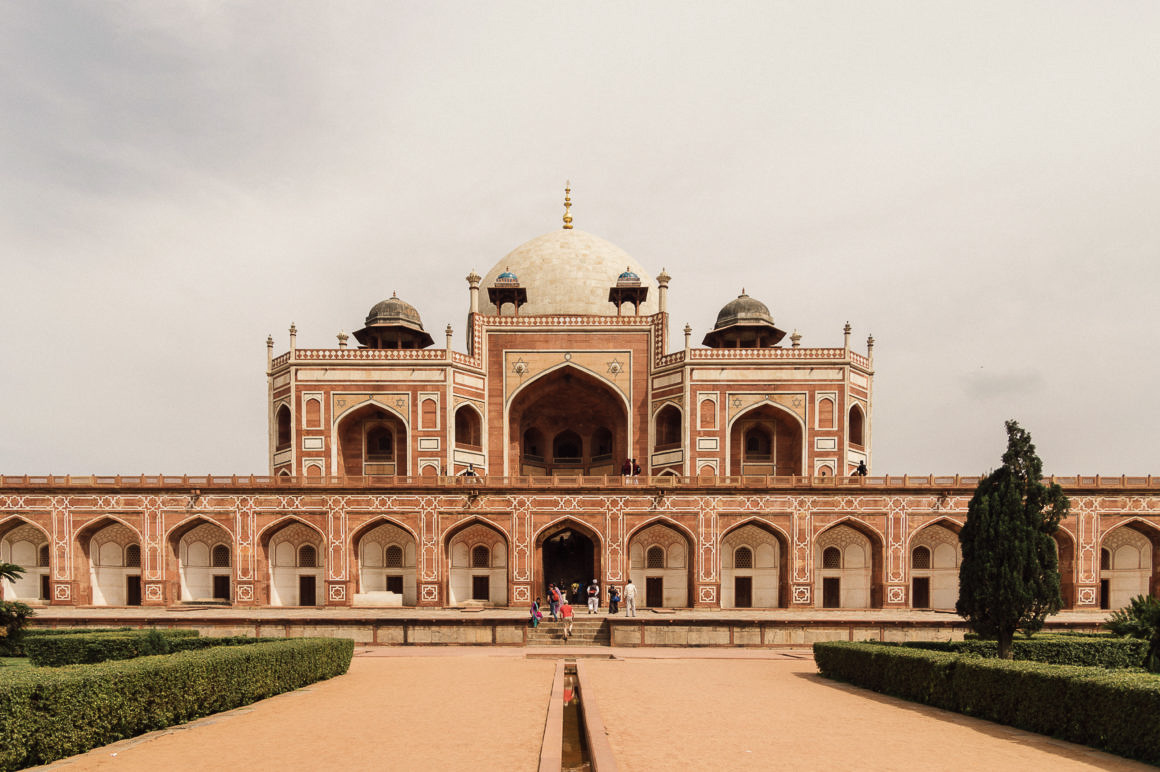 Delhi, India · Mughal architecture at first light · © Raffaele Ferrari
The Mughal Monuments — Where to Stand and When
Delhi contains more significant Mughal monuments than any other city in India. The challenge for the photographer is not finding them — it is understanding which ones reward serious photographic attention and which ones are primarily tourist attractions with limited visual depth.
Humayun’s Tomb — The Finest Photography Subject in Delhi
Humayun’s Tomb is the monument I return to every time I am in Delhi. Built in 1570 as the first garden-tomb on the Indian subcontinent, it is the direct architectural predecessor of the Taj Mahal and, in many ways, a more interesting photography subject — less crowded, more geometrically complex, and recently restored to a condition that reveals the original quality of the red sandstone and white marble in extraordinary clarity.
The best light for the main facade arrives in the late afternoon — the west-facing facade illuminated at golden hour from a low angle that brings out the depth and colour of the sandstone. The morning is better for the garden and the secondary monuments within the complex, particularly the tomb of Isa Khan, which is most beautiful in the early light that arrives through its eastern gateway openings. The full photography approach to Humayun’s Tomb is covered in detail in the dedicated guide.
Qutb Minar — Geometry and the History of Stone
The Qutb Minar complex in south Delhi contains the oldest surviving mosque in India and one of the most extraordinary concentrations of early Indo-Islamic architecture on the subcontinent. The minaret itself — 73 metres of intricately carved red sandstone, the tallest brick minaret in the world — is a photography subject of genuine complexity: the carved verses from the Quran, the geometric banding of the surface, the relationship between the minaret and the ruins of the mosque courtyard around it.
Arrive at opening time. The first light on the east face of the minaret produces conditions that the midday tourist visit cannot replicate. The archaeological complex is large enough to absorb the crowd that arrives later, and in the early morning the ruins have a quality of emptiness that reveals their actual scale.
Jantar Mantar — The Surrealist Observatory
The Jantar Mantar in central New Delhi is the most photographically unusual subject in the city — an 18th-century astronomical observatory consisting of thirteen massive masonry instruments built by the Maharaja of Jaipur in 1724. The scale and geometry of these instruments — sundials, eclipse predictors, hour-angle calculators — produce a visual environment that has nothing to do with conventional architectural photography. The forms are abstract, the shadows they cast at different hours are dramatic, and the relationship between the instruments and the sky above them changes completely with the position of the sun.
A better and larger version of Jantar Mantar exists in Jaipur — but Delhi’s version is less visited and easier to photograph without crowds. Mid-morning, when the sun is high enough to create the precise shadows that define the geometry of the instruments, is the optimal time.
 Delhi, India · © Raffaele Ferrari
Jama Masjid — Scale, Light and the Friday Prayer
The Jama Masjid, built by Shah Jahan between 1644 and 1656, is one of the largest mosques in India and one of the most visually powerful architecture subjects in Delhi. The scale of the courtyard — which can accommodate 25,000 worshippers — is difficult to photograph from within, but the view from the southern minaret across the courtyard toward the prayer hall, and the view from outside the eastern gateway looking up at the facade, are both extraordinary.
The Friday prayers are the most significant documentary photography opportunity the mosque offers — the courtyard fills completely and the visual density of the congregation, the architecture and the light creates conditions unavailable on any other day of the week. Arrive early, position yourself in the courtyard before the prayer begins, and work quietly and respectfully throughout.
Non-Muslims are permitted to visit outside prayer times with an entrance fee. Photography is permitted throughout the complex.
When to Photograph Delhi — Season and Hour
October to February is the optimal photography season. The light is lower in angle, the temperatures are manageable for full days on foot, and the air — while affected by winter pollution in December and January — is clearer than at any other time of year. October and November are the best overall months: the post-monsoon clarity produces a quality of light on the monuments that the winter haze reduces.
Dawn to 9am is the most productive window every day. In Old Delhi this is the wholesale market hour — the visual material is completely different from the midday version. For the monuments, early morning light produces conditions on the east-facing facades that do not exist at any later hour. By 10am in Delhi the tourist infrastructure has fully activated and the conditions for serious photography have largely passed.
Delhi Photography — Practical Information
- Best months: October to February — lower light angle, post-monsoon clarity
- Best hours: Dawn to 9am for markets and monuments — every day without exception
- Getting around: Delhi Metro covers all major photography locations — reliable, air-conditioned, fast. Avoid auto-rickshaws for longer distances; use app-based taxis (Uber/Ola) for direct access to monuments
- Humayun’s Tomb: Hazrat Nizamuddin Metro (Violet Line). Open sunrise to sunset
- Qutb Minar: Qutb Minar Metro (Yellow Line). Open 7am to 5pm
- Chandni Chowk: Chandni Chowk Metro (Yellow Line). Market from 5am daily except Sunday
- Tripod: Permitted at Humayun’s Tomb and Qutb Minar. Not always permitted inside mosques — ask before setting up
- Drone: Not permitted inside any ASI-protected monument complex in Delhi
Delhi as the Opening Chapter — How It Prepares You for Rajasthan
Every India photography expedition I lead begins in Delhi — not because it is the most spectacular destination, but because it is the best preparation for what follows. The visual complexity of Old Delhi teaches the eye to read a crowded frame. The scale of the Mughal monuments teaches patience and the discipline of returning to the same subject in different light. The chaos of the traffic and the markets teaches the kind of alert, mobile attention that documentary photography in India requires.
Photographers who arrive in Rajasthan without having spent serious time in Delhi tend to be overwhelmed by the visual density of the Pushkar Camel Fair or the market life of Jodhpur. Those who have worked Delhi first arrive already calibrated — their eye accustomed to the pace, their camera position instinctive. Delhi does not produce the most beautiful photographs of the India journey. It produces the photographers who make the best ones.
Arrive before the city wakes. Work the markets at dawn. Return to the monuments in the late afternoon. Delhi gives its best to the photographer who is already there when it begins.Maximum 4 photographers. Heritage accommodation. Ten days through northern India — from the Mughal monuments and markets of Delhi to the extraordinary documentary photography of the Pushkar Camel Fair. Individual mentoring. Heritage accommodation included. Discover the Rajasthan Expedition →
Photograph Humayun’s Tomb — The Complete Guide · Rajasthan Photography Expedition — Pushkar Camel Fair · How to Photograph Jodhpur — the Blue City · Kerala vs Rajasthan — Which Workshop Is Right for You? · Kerala Photography Workshop · All Photography Workshops



4 Comments