Landscape in travel photography

Journal · On Photography · Landscape
Landscape in Travel Photography:
Why the Place Must Come Before the Camera
Landscape photography in travel is the most practised genre and, in my experience, the most misunderstood. Not technically — there are excellent guides on exposure, composition and light. But conceptually. The majority of travel landscape photographers approach a location as a visual resource to be exploited. They arrive, they photograph, they leave. The images they make look like the images everyone else makes from the same location, because they are made with the same relationship to the place — that of a visitor extracting an image rather than a photographer trying to understand something.
I have been photographing landscapes across four continents for more than twenty years — from the high-altitude lakes of Ladakh to the Gobi Desert of Mongolia, from the hills of Tuscany to the volcanic coast of Sicily. The single most important thing I have learned is this: the landscape photograph begins long before you raise the camera. It begins in the understanding of the place — its light, its culture, its rhythm, its history.
A landscape is not a view. It is a place that has been formed by centuries of human presence, climatic condition and geological time. The photographer who understands this produces images that communicate something. The photographer who sees only a view produces images that document it.
Tuscany, Sicily, Amalfi, Venice.
Small groups. Individual mentoring. Year-round.
The approach described in this article applied in the field. Maximum 4 photographers. From €1,000.
Discover the Workshops →
The First Problem — Arriving Too Quickly
The most common mistake in landscape travel photography is arriving at a location and immediately beginning to photograph. The first images from any new location are almost always the weakest. They are made before you understand what you are looking at — before you have read the light, understood the geometry of the place, identified the foreground and background relationships that will eventually produce a strong composition.
The photographers whose landscape work I most admire share one practice: they arrive before they need to. They spend time in a location without photographing — walking it, observing it, understanding what it looks like at different hours and in different weather. This time is not wasted. It is the foundation of every strong image that follows.
On my first visit to Tso Moriri in Ladakh, at 4,595 metres altitude, I spent the entire first day walking the lake shore without a camera. I watched the light change from dawn to dusk. I understood where the reflections would form in the early morning and at what hour the wind would disturb the surface. The following morning I made the images I had been preparing all day. They are among the strongest landscape photographs I have ever made — not because of technical excellence, but because I understood what I was photographing before I photographed it.

Tso Moriri, Ladakh, India · © Raffaele Ferrari
Light — The Variable That Determines Everything
Every landscape photographer knows that light matters. What fewer understand is precisely how much it matters and how completely it determines what is and is not photographable at any given moment. The difference between a landscape in flat overhead light and the same landscape at golden hour is not a difference of degree — it is a difference of kind. The flat-light photograph records the existence of the place. The golden-hour photograph communicates something about it.
The Sea — Working with Movement and Long Exposure
Coastal landscape photography rewards the photographer who understands the relationship between light and water. The sea at long exposure — ten seconds, thirty seconds, sometimes minutes — becomes a surface of extraordinary smoothness and texture that no single-moment image can replicate. The wave patterns, the foam, the interaction of moving water with rock and sand — all of this is available only to the photographer willing to use a tripod and work the exposure times that reveal it.
The best coastal light is available in a narrow window around dawn and dusk. The horizontal light of these hours illuminates the texture of the water surface and the cliffs above it from a low angle that produces three-dimensionality impossible at any other time. In the Mediterranean particularly — Sicily, the Amalfi Coast, the Algarve — the golden hour on coastal cliffs produces colours that painters have been trying to capture for centuries.
Mountain Landscape — Scale, Patience and the Long View
Mountain landscape photography is the most demanding genre in travel photography because the conditions are the least controllable and the most rapidly changing. The light that illuminates the Himalayan peaks at dawn exists for minutes before the sun rises high enough to flatten it. The clouds that sit on a mountain range in the morning may burn off by midday or may thicken into a storm by afternoon. Working in mountain landscape requires the willingness to spend long periods waiting for conditions that may not arrive — and to be in exactly the right position when they do.
Ladakh taught me more about patience in landscape photography than any other environment I have worked in. The scale of the landscape is so extreme that a slight shift in the quality of the light — from flat overcast to a brief break in the cloud — transforms the visual character of the entire scene. The photographer who is not already in position when that break comes makes nothing. The photographer who has been waiting for three hours makes the image of the day.
Desert — Simplicity and the Long Shadow
The desert is the landscape that most directly rewards the photographer with a minimalist eye. The Gobi Desert of Mongolia, the Thar Desert of Rajasthan, the volcanic plains of Iceland — all share a quality of visual clarity that is unique: clean lines, defined horizons, the extreme contrast between the lit and shadow faces of dunes and rock formations in the low light of early morning and late afternoon.
The most powerful desert images are almost always the simplest. A single figure against an empty horizon. A dune crest in the raking light of golden hour. The shadow of a camel stretching across the sand in the last minutes of the day. The temptation to complicate the composition — to include more elements, to fill the frame — works against the essential nature of the desert subject.

Gobi Desert, Mongolia · © Raffaele Ferrari
The Cultural Layer — What Most Landscape Photographers Miss
The deepest landscapes in travel photography are those that carry the evidence of human presence — not intrusive, not dominant, but present. A shepherd’s path worn into a hillside over generations. A stone wall built by hands in a specific century for a specific agricultural purpose. A temple positioned on a ridge for reasons that combine the practical with the spiritual. These elements transform a landscape photograph from a record of natural scenery into a document of human culture within a natural environment.
My background in psychology has shaped how I read landscapes. Every place carries the imprint of the culture that has lived within it — in the way the land has been worked, in the buildings placed within it, in the paths that connect one point to another. Understanding this cultural layer changes what you see when you look at a landscape. It reveals subjects and relationships that are invisible to the photographer looking only for the scenic view.
In Tuscany, the cypress-lined roads of Val d’Orcia were not planted for aesthetic reasons. They mark the boundaries of medieval agricultural estates and provide shelter from the wind for the fields alongside them. The photographer who knows this sees the cypress lines as a document of centuries of agricultural history as well as a compositional element. The resulting image carries more depth than the one made purely for the visual effect of the trees against the sky.
The most powerful landscape photographs
are always about more than the landscape.
They are about the culture that shaped it
and the time that formed it.
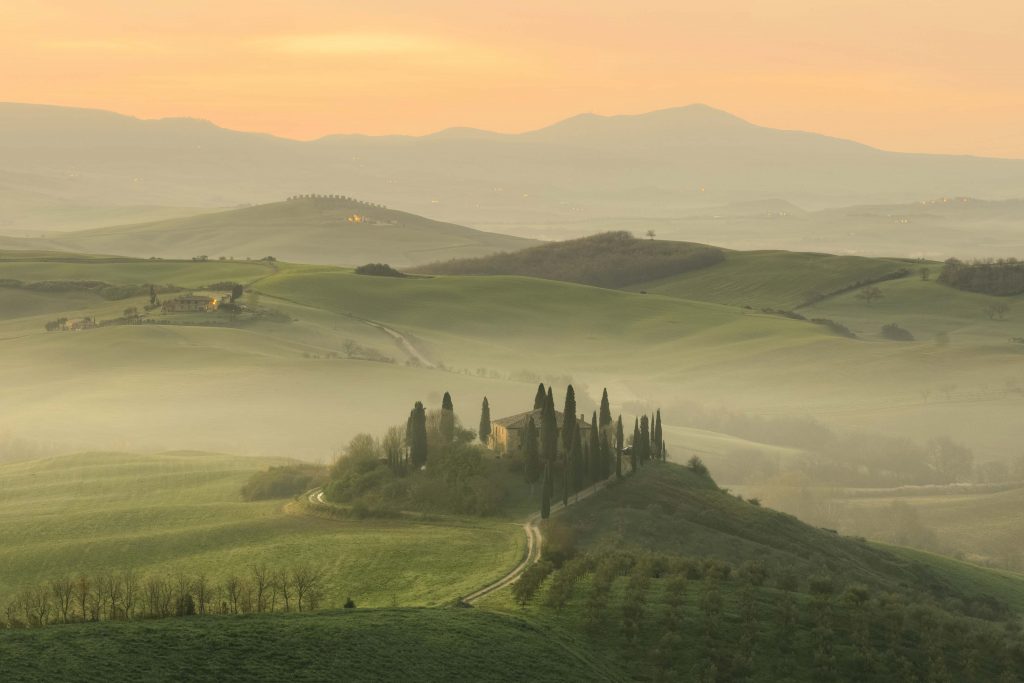
Val d’Orcia, Tuscany · © Raffaele Ferrari
Five Principles for Stronger Landscape Photography in Travel
Arrive before the light. The most productive position in any landscape is the one you occupy before the conditions arrive. This means understanding — from maps, from local knowledge, from a previous visit on foot without the camera — where the light will fall and at what hour. The photographer who arrives at the location simultaneously with the golden hour is always a fraction too late. The photographer who has been there for thirty minutes is ready.
Return to the same location. The strongest landscape photographers return to their subjects repeatedly — in different seasons, in different weather, at different hours. Ansel Adams photographed Yosemite across decades. Hiroshi Sugimoto has photographed the same seascape horizon for forty years. The depth that accumulates through repeated engagement with a single place produces images that a single visit cannot. Where your itinerary allows it, return.
Learn the light through the culture. Every landscape has a quality of light that is specific to its geography and climate — and that quality is always connected to the human culture that has evolved within it. The Renaissance painters of Tuscany studied the local light with the same rigour that a scientist studies a natural phenomenon. That depth of attention is still available to any photographer willing to give it the time it requires.
Simplify the composition. The most common compositional failure in landscape travel photography is excess. Too many elements, too much foreground, too complicated a relationship between the components of the frame. The landscapes that communicate most powerfully are almost always the simplest — the single line of cypress trees against the Tuscan sky, the lone yurt on the Mongolian steppe, the wave breaking against a single rock. Simplicity is a discipline, not a limitation.
Photograph what you feel, not what you see. The technical record of a landscape — accurate exposure, sharp focus, correct white balance — is the beginning of a photograph, not its completion. The image that communicates something to the viewer who was not there is always the image that carries some quality of the photographer’s response to the place — wonder, solitude, the particular quality of silence at high altitude. This cannot be taught technically. It can only develop through the kind of deep engagement with landscape that comes from slowing down, staying longer and caring genuinely about the place rather than about the image it might produce.
Study the Masters — The Landscape Photographers Who Changed How We See
The most productive investment any landscape photographer can make is time spent looking at the work of photographers who have understood landscape at the deepest level. Not to copy their style but to understand their thinking — the decisions they made about where to stand, when to press the shutter, what to include and what to exclude.
Ansel Adams approached the American West with the rigour of a scientist and the sensitivity of a musician. His zone system was not merely a technical tool — it was a way of thinking about light that informed every compositional decision he made. Hiroshi Sugimoto’s seascape series reduces the landscape to its most fundamental elements — water, sky, the horizon between them — and discovers within that reduction an infinite visual territory. Michael Kenna returns to the same locations across decades, building a body of work that no single visit could produce. Josef Koudelka’s landscape photographs carry the same documentary weight as his people photographs — the landscape as a document of history rather than a celebration of scenery.
These photographers have in common an approach to landscape that is anything but passive. They bring a point of view, a cultural understanding and a sustained engagement that transforms the landscape from a subject into a conversation.
Tuscany at dawn. Rajasthan in November.
Ladakh in the high season of light.
The principles described in this article form the foundation of every workshop I lead — in Italy, Europe and Asia. Maximum 4 photographers. Individual mentoring. Accommodation included in most destinations.
View All Photography Workshops →
Continue reading:
Photography Workshop in Tuscany ·
Rajasthan Photography Expedition ·
Kerala Photography Workshop ·
How to Photograph Val d’Orcia ·
Why Small Group Photography Workshops ·
Photography Workshop vs Photography Tour


3 Comments