Festivals to photograph in Southeast Asia
Raffaele Ferrari · Southeast Asia Photography · Field Guide
Festivals to Photograph in Southeast Asia — A Photographer’s Field Guide
The events that define a culture are the hardest to photograph well — and the most rewarding when you do. What twenty years in Southeast Asia has taught me about working festivals with a camera.
The most intense documentary photography I have ever done has been at festivals. Not because festivals are easy — they are the opposite of easy. But because they are the moments when a culture becomes most visible to itself, and therefore most available to an outside eye willing to pay the right kind of attention.
Southeast Asia has a festival calendar unlike anywhere else in the world. The density and diversity of Buddhist, Hindu, Muslim, animist and syncretic celebrations across a relatively small geographic area means that in almost any month of the year, in almost any country in the region, something is happening that has been happening in the same form for centuries. Monks in saffron robes at dawn. Lanterns rising in their thousands over the dark surface of a lake. A city centre flooded with the sound and colour of a water festival that has been marking the new year since before the current nations existed. These are not performances created for tourists. They are genuine cultural expressions — and that genuineness is precisely what makes them so demanding and so rewarding to photograph.
This guide does not attempt to cover every festival in Southeast Asia. It focuses on the ones I have photographed personally — the events where I have learned something about festival photography specifically, and about the documentary approach to culture more generally. The festivals of Thailand appear most prominently, because Thailand is the country I know best and return to most consistently. But the principles apply across the region, from the Vesak celebrations of Cambodia and Myanmar to the Eid festivals of Malaysia and Indonesia.
Why Festivals Are the Most Demanding and Most Rewarding Documentary Subject
A festival compresses into a few hours or days everything that makes documentary photography difficult: the crowds, the movement, the low and unpredictable light, the ceremonies conducted in languages and ritual logics the photographer may not fully understand, the tension between the desire to photograph and the responsibility not to disrupt what you are photographing. One mistake I see photographers making at festivals over and over again is treating the spectacle as the subject. They photograph the biggest, most colourful, most dramatically lit elements — the fireworks, the processional floats, the moment of peak ceremony — and return home with images that are visually impressive and emotionally hollow.
The images that stay with you from a festival are almost never the obvious ones. They are the monk preparing quietly in the pre-dawn before the ceremony begins. The child watching the procession from a doorway. The old woman making an offering at a shrine that is slightly away from the main event, in a shadow that most photographers walked past. These marginal subjects — the edges of the festival rather than its centre — are where the documentary material of genuine depth exists.
The festival is not the subject. The people living inside the festival are the subject. That distinction changes everything about how you move through the event with a camera.
After more than twenty years of photographing festivals across Southeast Asia, I have learned that the preparation that matters most is not logistical — it is cultural. Understanding what a festival is actually celebrating, what its religious or historical significance is, what the specific rituals mean to the people performing them — this knowledge changes the quality of attention you bring to every frame. The photographer who knows that the Vesak lanterns represent the Buddha’s enlightenment, birth and death sees something different in the faces of the people releasing them than the photographer who sees only a visually spectacular light show.
Thailand — Three Festivals Worth Planning Your Trip Around
 Thailand. The monks at dawn — photographed not during the ceremony but in the minutes of preparation that precede it. The best festival photographs are almost always made at the margins.
Songkran — The Water Festival · April
Songkran — the Thai new year, celebrated in mid-April — is the most photographically intense festival I have experienced in Southeast Asia. The official version, which involves water being poured respectfully over the hands of elders and Buddha images in a ceremony of blessing and purification, has been substantially overlaid in most major cities by an enormous public water fight that lasts three days. In Chiang Mai, the moat around the old city becomes a continuous battle zone. In Bangkok’s Silom Road, the water and the chaos reach an intensity that makes photography both technically demanding and physically hazardous.
The documentary opportunity within Songkran is not the water fight itself — that produces visually spectacular images that already exist in enormous numbers. It is the quieter ceremony conducted inside the temples while the street battle rages outside: the families bringing offerings to the monks, the elderly participating in the blessing rituals with an attention and dignity that the noise outside does not disturb. Working both registers — the intensity of the street and the quietness of the temple — in the same day produces a portrait of Songkran that the obvious images of water battles cannot.
Yi Peng — The Lantern Festival · November
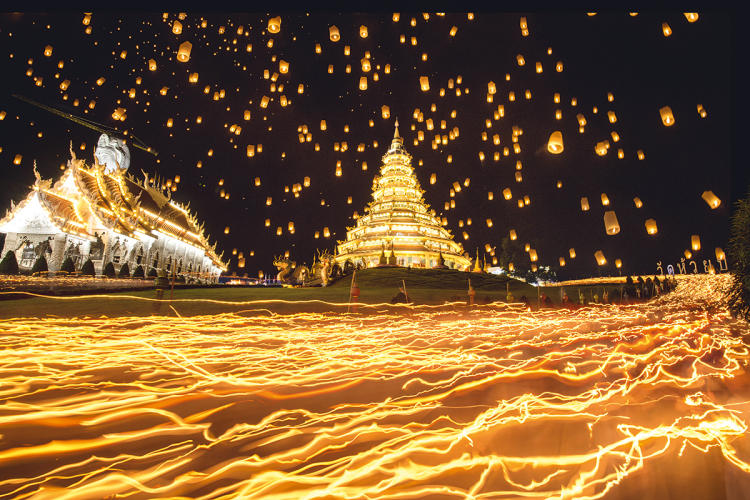
The Yi Peng lantern festival in Chiang Mai — held on the full moon of the second month of the Lanna lunar calendar, which typically falls in November — is one of the most photographed festival events in Southeast Asia, and for obvious reasons: ten thousand paper lanterns rising simultaneously from a field outside the city, carried upward by the heat of the candle inside each one, is a visual spectacle of extraordinary beauty. The photographs of it exist in almost incomprehensible quantities.
The more interesting photography at Yi Peng happens not at the main mass lantern release — which is crowded beyond practical documentary work — but at the smaller releases conducted throughout the city in the days surrounding the main event. Families releasing lanterns from the banks of the Ping River at dusk. The preparations: the assembly of the lanterns, the lighting of the candle, the moment of release and the upward movement of the flame. The face of the person watching their lantern diminish into the darkness above the city. These are the images that carry the actual meaning of the festival rather than simply its visual scale.
Loi Krathong — The Floating Offering · November
Loi Krathong is celebrated on the same full moon night as Yi Peng — making November in Chiang Mai one of the most extraordinary festival photography opportunities in the world. Krathong are small floating offerings — lotus-shaped baskets made of banana leaf, containing flowers, incense and a candle — that are released onto rivers, canals and ponds throughout Thailand as an act of thanksgiving and release. The combination of the floating offerings on the water and the lanterns above it, on a clear full-moon night, produces a visual environment unlike anything I have seen elsewhere.
The photography that works here is patient and close. Not the wide shot that tries to capture the entire spectacle — that image exists and does not need to be made again. The close portrait of the person releasing their krathong, the reflection of the candle flame on the water surface, the hands assembling the offering in the hours before the festival begins. These intimate, specific images carry the spiritual weight of the festival in a way that the wide spectacular shots cannot.
Vesak. The celebration of the Buddha’s birth, enlightenment and death — photographed not at the moment of peak ceremony but in the preparation that makes ceremony possible.
Thailand. The monks at dawn — photographed not during the ceremony but in the minutes of preparation that precede it. The best festival photographs are almost always made at the margins.
Songkran — The Water Festival · April
Songkran — the Thai new year, celebrated in mid-April — is the most photographically intense festival I have experienced in Southeast Asia. The official version, which involves water being poured respectfully over the hands of elders and Buddha images in a ceremony of blessing and purification, has been substantially overlaid in most major cities by an enormous public water fight that lasts three days. In Chiang Mai, the moat around the old city becomes a continuous battle zone. In Bangkok’s Silom Road, the water and the chaos reach an intensity that makes photography both technically demanding and physically hazardous.
The documentary opportunity within Songkran is not the water fight itself — that produces visually spectacular images that already exist in enormous numbers. It is the quieter ceremony conducted inside the temples while the street battle rages outside: the families bringing offerings to the monks, the elderly participating in the blessing rituals with an attention and dignity that the noise outside does not disturb. Working both registers — the intensity of the street and the quietness of the temple — in the same day produces a portrait of Songkran that the obvious images of water battles cannot.
Yi Peng — The Lantern Festival · November
The Yi Peng lantern festival in Chiang Mai — held on the full moon of the second month of the Lanna lunar calendar, which typically falls in November — is one of the most photographed festival events in Southeast Asia, and for obvious reasons: ten thousand paper lanterns rising simultaneously from a field outside the city, carried upward by the heat of the candle inside each one, is a visual spectacle of extraordinary beauty. The photographs of it exist in almost incomprehensible quantities.
The more interesting photography at Yi Peng happens not at the main mass lantern release — which is crowded beyond practical documentary work — but at the smaller releases conducted throughout the city in the days surrounding the main event. Families releasing lanterns from the banks of the Ping River at dusk. The preparations: the assembly of the lanterns, the lighting of the candle, the moment of release and the upward movement of the flame. The face of the person watching their lantern diminish into the darkness above the city. These are the images that carry the actual meaning of the festival rather than simply its visual scale.
Loi Krathong — The Floating Offering · November
Loi Krathong is celebrated on the same full moon night as Yi Peng — making November in Chiang Mai one of the most extraordinary festival photography opportunities in the world. Krathong are small floating offerings — lotus-shaped baskets made of banana leaf, containing flowers, incense and a candle — that are released onto rivers, canals and ponds throughout Thailand as an act of thanksgiving and release. The combination of the floating offerings on the water and the lanterns above it, on a clear full-moon night, produces a visual environment unlike anything I have seen elsewhere.
The photography that works here is patient and close. Not the wide shot that tries to capture the entire spectacle — that image exists and does not need to be made again. The close portrait of the person releasing their krathong, the reflection of the candle flame on the water surface, the hands assembling the offering in the hours before the festival begins. These intimate, specific images carry the spiritual weight of the festival in a way that the wide spectacular shots cannot.
Vesak. The celebration of the Buddha’s birth, enlightenment and death — photographed not at the moment of peak ceremony but in the preparation that makes ceremony possible.
Thailand. The monks at dawn — photographed not during the ceremony but in the minutes of preparation that precede it. The best festival photographs are almost always made at the margins.
Photography Workshop · Thailand & Cambodia
The Soul of Thailand — Documentary Photography Workshop · January 2027
The same documentary approach described in this guide — patience, cultural preparation, working the margins rather than the spectacle — applied to ten days in Bangkok and Cambodia. January 20–30, 2027. Maximum 6 participants. Individual mentoring. No deposit required.
Discover The Soul of Thailand Workshop →
Cambodia and Myanmar — Vesak and the Buddhist Calendar
Vesak — The Buddha’s Birthday · May
Vesak — the celebration of the Buddha’s birth, enlightenment and death, observed on the full moon of the fourth month of the Buddhist lunar calendar — is marked with varying intensity across all Buddhist countries of Southeast Asia. In Cambodia and Myanmar, it is among the most visually extraordinary events of the year: the temples illuminated, the monks in full ceremony, the lay population making offerings and circumambulating the sacred structures through the night. I have photographed Vesak at Angkor — where the ceremonies take place within the temple complex itself, creating a documentary environment in which the ancient and the living are indistinguishable — and it remains one of the most demanding and most rewarding festival photography experiences I have had.
The key to photographing Vesak, or any Buddhist festival, is to arrive long before the ceremony and stay long after it. The preparations — the monks arranging the offerings, the lay volunteers decorating the temple, the families who travel significant distances to be present — contain the documentary material that the ceremony itself, with its defined positions and its prescribed movements, sometimes cannot. And the aftermath — the quiet of the temple in the early hours after the main ceremony, the monks returning to their routines, the candles burning down — is where the images that carry the genuine weight of the event tend to live.
Vesak. The celebration of the Buddha’s birth, enlightenment and death — photographed not at the moment of peak ceremony but in the preparation that makes ceremony possible.
How to Photograph Festivals — What Twenty Years Has Taught Me
Prepare culturally, not just logistically. Before any festival, understand what is being celebrated, what the specific rituals mean, and what the appropriate conduct for a non-participant photographer is. This knowledge changes the images you make — and it changes how you are received by the people you photograph.
Arrive early and work the margins. The best festival photographs are almost never made at the peak of the main event. They are made in the preparation — the two hours before the ceremony begins when the ritual space is being created — and in the quiet aftermath. The edges of the festival: the side streets, the quieter shrines away from the main procession, the individuals who are participating in their own way rather than in the crowd.
Work close and slow rather than wide and fast. The reflex at a festival is to use a wide lens and cover as much visual ground as possible. The images that work are usually made with a 35mm or 50mm prime at close range, with enough time spent in a single position to understand what is actually happening there. One story told completely is more valuable than ten stories skimmed.
Photograph people, not spectacle. The fireworks, the processional floats, the lanterns in the sky — these are beautiful and they are already thoroughly photographed. The people experiencing these things: their faces, their gestures, their relationship to the ceremony — this is where the documentary depth of a festival lives. The face of the person releasing their lantern is more interesting than the lantern itself.
Be present before you photograph. At religious festivals especially, the quality of your presence matters more than the quality of your equipment. Move slowly. Observe before raising the camera. Ask permission when the situation requires it. The photographs made after genuine human engagement are different in kind from those made as a form of visual extraction from an unsuspecting crowd.
Southeast Asia Festival Calendar — When to Plan Your Trip
Planning a photography trip around a specific festival requires understanding that many Southeast Asian festivals follow lunar calendars, which means their Gregorian dates shift from year to year. The broad seasonal framework is stable; the specific dates require verification in the year of your visit.
January — Thaipusam, Malaysia and Singapore
Thaipusam — the Hindu festival of Lord Murugan, observed primarily by Tamil communities — produces some of the most visually extraordinary and most demanding photography in Southeast Asia. The kavadi bearers, who carry elaborate metal structures attached to their bodies through hooks and skewers as acts of devotion, create images of a visual intensity that requires significant cultural preparation to approach with appropriate understanding. Georgetown in Penang and the Batu Caves in Kuala Lumpur are the principal locations in the region. January is also the optimal month for photography in Thailand — dry season, clear light, and the full rhythm of Bangkok’s daily life at its most accessible.
April — Songkran, Thailand and the New Year Region
April brings the new year festivals of the Buddhist mainland Southeast Asia: Songkran in Thailand, Thingyan in Myanmar, Bun Pi Mai in Laos. All involve water — the ceremonial and the celebratory — and all offer the dual documentary register of the quiet temple ceremony and the exuberant public celebration. Chiang Mai and Bangkok are the primary Songkran destinations for photographers; Mandalay and Bagan offer a different and less internationally crowded version of the same cultural moment in Myanmar.
May — Vesak Across the Buddhist World
Vesak falls on the full moon of the fourth Buddhist lunar month — typically in May. The most photographically extraordinary Vesak celebrations in the region are in Cambodia (particularly at Angkor Wat), Myanmar (at the pagodas of Mandalay and Bagan) and Thailand. Each country’s version of the festival has its own specific character, and the photographer who has spent time understanding the religious context will find the documentary material significantly richer than the one who arrives for the visual spectacle alone.
November — Yi Peng and Loi Krathong, Chiang Mai
The full moon of November in Chiang Mai produces the combination of Yi Peng lantern releases and Loi Krathong floating offerings described above — arguably the single most photographically concentrated festival moment in Southeast Asia. The dates shift with the lunar calendar; the experience is consistent. Plan accommodation in Chiang Mai months in advance for this period, and plan your photography around the smaller, more intimate releases rather than the mass commercial event at the Maejo University grounds, which is extraordinary to witness but impossible to work photographically.
Festival Photography and the Larger Practice
The skills that festival photography develops — cultural preparation, patience, the discipline of working the margins rather than the spectacle, the ability to be present in a crowded and intense environment without disrupting what you are there to photograph — transfer directly to every other form of documentary work. The photographer who has learned to work a Buddhist ceremony in Cambodia has also learned how to work a market in Bangkok, a fishing harbour in southern Thailand, a temple courtyard in Ayutthaya before sunrise.
This is why festivals appear in the workshops I lead in Southeast Asia not as special occasions but as concentrated versions of the everyday documentary approach. The Thailand Photography Guide covers the broader documentary approach to the country that underpins festival work. The Ayutthaya Photography Guide describes the same patient, culturally informed approach applied to a historical site rather than a festival. And the essay on visual storytelling in travel photography provides the philosophical foundation for all of it.
Festival Photography in Southeast Asia — Frequently Asked Questions
What is the best festival to photograph in Southeast Asia?
For sheer visual intensity combined with genuine cultural depth, the Yi Peng and Loi Krathong combination in Chiang Mai in November is extraordinary. For documentary photography specifically, Vesak at Angkor Wat in Cambodia offers an environment — ancient temples, living ceremony, remarkable light — that is impossible to replicate elsewhere. Songkran in Thailand in April offers the widest range of documentary registers. The best festival for any individual photographer depends on what kind of images they are trying to make and what level of cultural preparation they are willing to invest.
What camera equipment is best for festival photography in Southeast Asia?
A compact mirrorless system — Fuji X or Leica M — with a 35mm or 50mm prime is ideal for the close documentary work that produces the most interesting festival images. Small cameras move through crowds without disruption and allow close-range photography without the camera creating a barrier between photographer and subject. Good high-ISO performance is essential for the low-light conditions of evening and pre-dawn ceremonies. A second body as backup is practical at Songkran, where the water makes equipment failure a genuine risk.
How do I photograph Buddhist ceremonies respectfully?
Understand the ceremony before you photograph it — what is being celebrated, what the specific rituals mean, what the appropriate conduct for a non-participant is. Arrive early, move slowly, and observe before raising the camera. In temple spaces, follow the behaviour of the worshippers: remove shoes, speak quietly, keep the camera lowered when inside the main worship area until you understand whether photography is appropriate. The monks and lay participants who see a photographer behaving respectfully almost always respond with openness. Those who see a photographer treating the ceremony as a spectacle to be documented generally do not.
When is the best time to photograph the Yi Peng lantern festival in Chiang Mai?
The Yi Peng festival falls on the full moon of the second month of the Lanna lunar calendar — typically in November. The specific Gregorian date shifts each year; check the current year’s calendar well in advance. The most photographically productive moments are not at the main mass commercial release but at the smaller, more intimate releases conducted by families at the Ping River and at the smaller temples throughout the city. These offer the close documentary access that the crowded main event cannot. Arrive in Chiang Mai two or three days before the main festival to photograph the preparations and the smaller pre-festival releases.
Is Songkran safe for camera equipment?
In the street water battle areas of Bangkok and Chiang Mai, water is everywhere and camera equipment is at genuine risk. Weather-sealed cameras and lenses are strongly recommended. Many photographers working Songkran use a single, weather-sealed body with a fixed prime lens rather than changing lenses in wet conditions. A dry bag or waterproof cover is practical for transit between locations. The temple ceremony areas are generally drier and more controlled — the water is contained in ceremonial bowls rather than water guns and hoses. Working these quieter spaces requires a different approach from the street battle but produces more documentarily interesting images with significantly less equipment risk.
Is there a photography workshop covering Southeast Asian festivals?
The Soul of Thailand Photography Workshop (January 2027) applies the documentary approach to festivals described in this guide to ten days in Bangkok and Cambodia. While the January dates do not coincide with the major festival periods, the Buddhist ritual life of Thailand and Cambodia — the morning alms, the temple ceremonies, the market culture — provides documentary photography material of comparable richness throughout the year. Maximum 6 participants. No deposit required to enquire.
What is the Vesak festival and where is it best photographed in Southeast Asia?
Vesak celebrates the birth, enlightenment and death of the Buddha — all believed to have occurred on the same full moon date. It falls in May and is observed across all Buddhist countries in Southeast Asia. The most photographically extraordinary Vesak celebrations are at Angkor Wat in Cambodia, where the ceremonies take place within the temple complex itself; at the pagodas of Mandalay in Myanmar; and at the major temples of Bangkok and Chiang Mai. The documentary approach — arriving before the ceremony, working the preparations and the margins, staying after the main event — applies at all of these locations.
How does festival photography connect to documentary photography more broadly?
Festival photography is documentary photography under concentrated conditions. The skills it develops — cultural preparation, patience, working the edges of an event rather than its centre, being present before photographing — transfer directly to all forms of documentary travel photography. The photographer who has learned to work a Buddhist ceremony in Cambodia has also learned how to work a market, a fishing harbour or a city street with the same quality of attention. The essay on how to tell better stories through travel photography covers the foundational approach.
The Soul of Thailand · Documentary Photography Workshop · January 2027
Experience Southeast Asia Through Photography
If the approach described in this guide — cultural preparation, patient observation, documentary depth over spectacular surface — is how you want to photograph Southeast Asia, The Soul of Thailand workshop is built around exactly that. Bangkok and Cambodia. January 20–30, 2027. Maximum 6 participants. No deposit required.
Discover The Soul of Thailand Workshop
Read also:
Thailand Photography Guide
·
Ayutthaya Photography Guide
·
How to Tell Better Stories Through Travel Photography